January 20, 2026
Understanding Fire Extinguisher Signage Meaning: A Complete Guide to Emergency Safety
Fire extinguisher signage meaning is fundamental to workplace safety and emergency preparedness. These visual markers serve as critical communication tools that direct people to life-saving equipment during fire emergencies. Whether you're managing an office building, warehouse, or commercial premises, understanding fire extinguisher signs ensures your facility complies with safety regulations while protecting lives and property.
If you're looking for fire extinguisher signs/signage, you can contact Signarama Wetherill Park.
What Does Fire Extinguisher Signage Mean?
Fire extinguisher signage refers to standardized visual indicators placed throughout buildings to identify the location and type of fire extinguishers available. These signs communicate essential safety information at a glance, enabling quick access to firefighting equipment when every second counts.
In Australia, fire extinguisher signs must follow Australian Standard AS2700, displaying a white symbol, border, and text on a red background. This distinctive color combination is instantly recognizable across cultural and language barriers, making it universally understood in emergency situations.
The Importance of Fire Extinguisher Signs in Fire Safety
Effective fire safety depends on more than just having equipment available—people must know where to find it and how to use it. Fire extinguisher signs fulfill this critical need by providing clear, immediate visual guidance during high-stress situations.
When a fire occurs, occupants often experience panic and disorientation. Strategic placement of fire extinguisher signage eliminates confusion, enabling rapid access to the right equipment. This swift response significantly increases the chances of containing small fires before they escalate into major incidents, directly protecting lives and property.
Research demonstrates that small workplace fires have a much higher possibility of containment when personnel can quickly locate extinguishers. Signage that's prominently displayed and properly positioned makes the difference between successfully suppressing a fire and watching it spread uncontrollably.

Fire Extinguisher Symbols and Their Meanings
Fire extinguisher symbols communicate which type of fire each extinguisher can safely handle. Understanding these symbols is essential because using the wrong extinguisher can worsen fires and endanger people.
Class A Fires
Involve ordinary combustibles such as wood, paper, textiles, and some plastics. The Class A symbol is a green triangle containing the letter A, with a pictogram showing a trash bin and firewood on fire. Class A extinguishers use water or dry powder to cool and suppress these fires.
Class B Fires
Involve flammable liquids including gasoline, oil, and paint, as well as other liquid fuels. Represented by a red square with the letter B, the Class B pictogram depicts a fuel can. These fires require extinguishers that smother flames without water, preventing liquid spread.
Class C Fires
Involve electrical equipment and energized electrical systems. The blue circle symbol with letter C indicates safe use on electrical fires. These extinguishers won't conduct electricity back to the user, making them essential in settings with extensive electrical infrastructure.
Class D Fires
Involve combustible metals such as magnesium, sodium, and potassium—common in industrial settings. The yellow star symbol with letter D alerts users to fires requiring specialized extinguishing agents designed specifically for metal combustion.
Class F Fires (Class K in some regions)
Involve cooking oils and fats found in commercial kitchens. The black hexagon with letter F represents wet chemical extinguishers designed to cool and smother these unique fires without causing dangerous splattering.
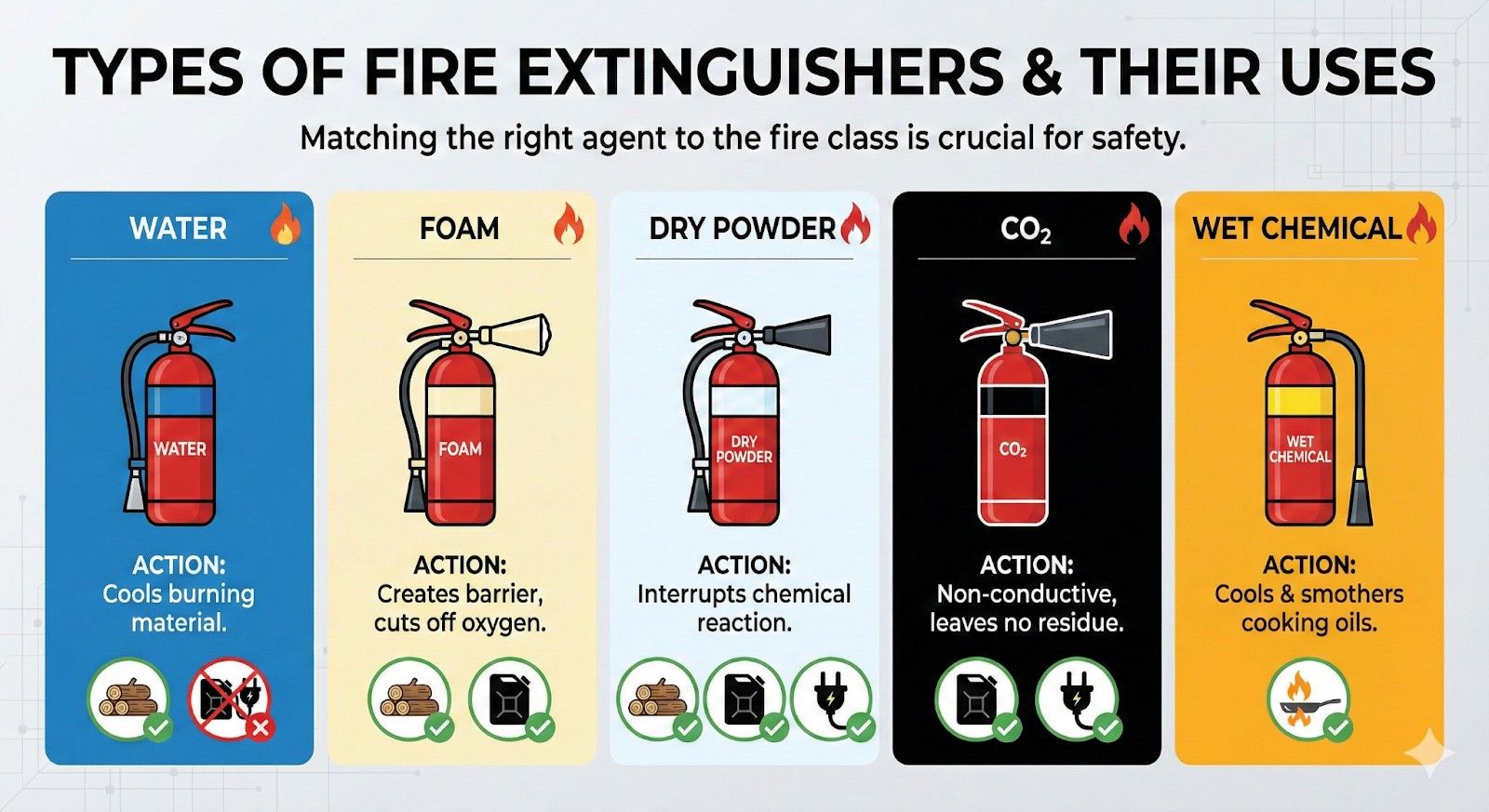
Understanding Different Types of Fire Extinguishers
The extinguisher signage meaning depends directly on knowing which type of fire extinguisher you're examining. Each type contains different extinguishing agents suited to specific fire classes.
- Water extinguishers: Best on Class A fires; dangerous on flammable liquids or electrical fires.
- Foam extinguishers: Handle Class A and B fires by creating a barrier between fuel and oxygen.
- Dry powder extinguishers: Versatile for Class A, B, and C fires.
- CO2 extinguishers: Ideal for Class B and C fires, especially with liquids and electrical hazards.
- Wet chemical extinguishers: Specifically for Class F fires in commercial kitchens.
Classes of Fire: The Complete Breakdown
Ordinary Combustibles (Class A)
Include wood, paper, textiles, rubber, and some plastics. Water-based extinguishers reduce temperature below combustion levels.
Flammable Liquids (Class B)
Require foam or dry powder extinguishers because water spreads these fires.
Flammable Gases (Class C)
Extinguishers must cool and interrupt combustion without damaging the gas container.
Combustible Metals (Class D)
Need specialized dry powder agents; water or standard extinguishers can cause violent reactions.
Electrical Equipment (Class E in Australia, Class C elsewhere)
CO2 and dry powder extinguishers work effectively without risking electrocution.
Cooking Oils and Fats (Class F)
Require wet chemical extinguishers to safely cool and smother oils.
Australian Standard Requirements for Fire Extinguisher Signs
- Must follow AS2700: white symbols, borders, and text on a red background.
- Signs must be positioned at least 2 meters above floor level.
- Signs must be placed directly above or adjacent to each extinguisher.
- Identification signs for extinguisher type (CO2, dry powder, etc.) are recommended.
Installation Guidelines for Effective Fire Extinguisher Signage
- Mount signs at eye level in high-traffic areas.
- Avoid doors, obstructions, or areas where visibility is blocked.
- Use appropriate fastening methods: tape for interior, industrial adhesives or screws for permanent placement.
- Regularly inspect signs to ensure visibility.
Safety Measures: Beyond Signage
- Maintain all fire equipment regularly.
- Conduct fire drills to familiarize staff with equipment.
- Train employees on the PASS method: Pull, Aim, Squeeze, Sweep.
- Educate staff about extinguisher types and their uses.
Protecting Lives and Property Through Signage
Fire extinguisher signs enable rapid response, preventing small fires from becoming catastrophic. Correct signage in industrial, kitchen, and office environments ensures safe and effective use of equipment.
Conclusion
Fire extinguisher signage goes beyond directional markers—it reflects your organization’s commitment to safety. By understanding symbols, complying with standards, and positioning signs strategically, you create an environment where people can respond effectively to fire emergencies. Combine proper signage with training to protect lives and property effectively.
Invest in quality fire extinguisher signs, maintain them properly, and provide comprehensive safety training to maximize protection.